
introduction
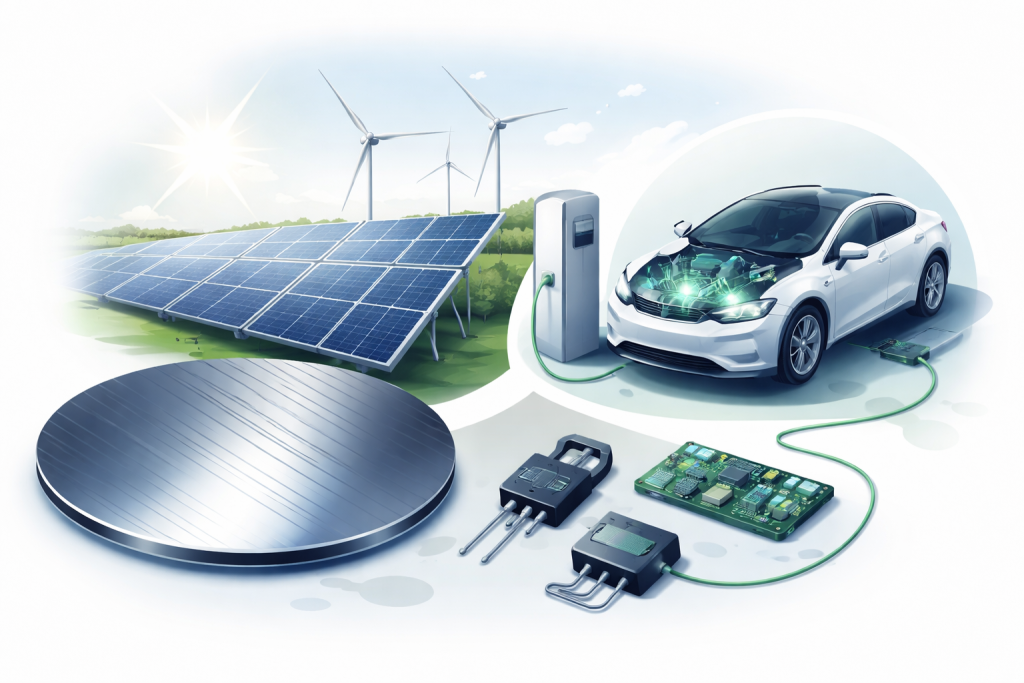
Silicon carbide (SiC) has emerged as a transformative material in the field of power electronics and optoelectronics. Traditionally applied in high-power and high-frequency semiconductor devices, SiC substrates are increasingly gaining attention in the renewable energy sector, particularly in photovoltaic (PV) systems and electric vehicles (EVs). This article explores the scientific and technological basis of SiC substrates, their potential applications in renewable energy, and the advantages and challenges associated with their adoption.
Material Properties of SiC Substrates
SiC is a wide-bandgap semiconductor material characterized by several unique properties that make it highly suitable for energy applications:
- Wide Bandgap: SiC has a bandgap of 3.26 eV for 4H-SiC and 3.0 eV for 6H-SiC, significantly wider than silicon (1.12 eV). This allows devices to operate at higher voltages, temperatures, and frequencies.
- High Thermal Conductivity: SiC substrates exhibit thermal conductivity up to 490 W/m·K, facilitating efficient heat dissipation and reducing the need for bulky cooling systems in high-power devices.
- High Electric Field Tolerance: SiC can withstand electric fields several times higher than silicon before breakdown, enabling compact, high-efficiency power devices.
- Mechanical and Chemical Stability: The hardness and chemical inertness of SiC make it robust against harsh environments, enhancing the durability of devices for renewable energy applications.
These intrinsic properties provide a foundation for SiC’s potential in PV and EV technologies, where energy efficiency, reliability, and high-temperature operation are critical.
SiC Substrates in Photovoltaic Applications
Photovoltaic energy conversion demands materials that can sustain high power densities and operate reliably under variable environmental conditions. SiC substrates contribute to PV systems primarily through the following avenues:
- High-Efficiency Inverters: Power inverters in solar installations require high-voltage switching devices. SiC-based metal-oxide-semiconductor field-effect transistors (MOSFETs) and Schottky diodes built on SiC substrates offer lower switching losses compared to silicon, improving overall inverter efficiency and reducing energy loss.
- Thermal Management: In large-scale PV arrays, power electronics generate significant heat. SiC’s superior thermal conductivity allows devices to operate at elevated temperatures without performance degradation, decreasing cooling requirements and operational costs.
- Reliability under Harsh Conditions: PV systems are often exposed to high temperatures, humidity, and mechanical stress. SiC substrates provide robustness against thermal cycling and corrosion, enhancing the lifespan of PV inverters and other associated electronics.
- Integration with Wide-Bandgap Photovoltaics: Emerging PV technologies, such as tandem solar cells and concentrated photovoltaic systems, benefit from SiC substrates as they can accommodate high-power and high-voltage requirements more effectively than traditional silicon-based devices.
Overall, SiC substrates enable PV systems to achieve higher energy conversion efficiency, compact device architecture, and long-term operational stability.
SiC Substrates in Electric Vehicle Applications
Electric vehicles rely heavily on efficient power electronics for traction inverters, onboard chargers, and DC-DC converters. SiC substrates are particularly well-suited for these applications due to the following advantages:
- Reduced Energy Losses: Traction inverters based on SiC MOSFETs reduce switching and conduction losses, improving overall vehicle efficiency. Studies indicate that SiC inverters can increase driving range by 5–10% compared to silicon-based inverters.
- High-Frequency Operation: SiC devices can operate at higher switching frequencies, enabling smaller passive components (capacitors, inductors) and reducing the size and weight of EV power modules. This contributes to lighter vehicles and increased energy efficiency.
- Enhanced Thermal Performance: EV power electronics generate substantial heat during operation. SiC substrates’ thermal conductivity and high-temperature tolerance reduce the need for elaborate cooling systems, simplifying design and lowering costs.
- Improved Reliability and Lifetime: EVs require electronics capable of enduring harsh operating conditions, including rapid charge/discharge cycles and wide temperature fluctuations. SiC substrates provide superior mechanical stability and resistance to thermal stress, enhancing long-term reliability.
The integration of SiC substrates in EV powertrains is a critical step toward high-efficiency, lightweight, and durable electric vehicles, aligning with global trends for sustainable transportation.
Challenges and Considerations
Despite the clear advantages, the widespread adoption of SiC substrates in renewable energy applications faces several challenges:
- High Material Cost: SiC substrates are significantly more expensive than silicon wafers due to complex crystal growth and polishing processes. This cost factor limits large-scale deployment in cost-sensitive PV markets.
- Manufacturing Complexity: Producing high-quality, defect-free SiC substrates requires advanced epitaxial growth techniques and precise surface finishing, which can affect yield and scalability.
- Device Packaging: The integration of SiC devices into existing inverter and EV architectures requires careful thermal and electrical design to fully utilize their performance advantages.
- Supply Chain Limitations: Currently, SiC substrate production is concentrated among a few specialized manufacturers, creating potential bottlenecks for high-volume applications.
Addressing these challenges through process innovation, cost reduction, and expanded manufacturing capacity is essential for unlocking the full potential of SiC in renewable energy sectors.
Future Outlook
The future of SiC substrates in renewable energy is promising. Advances in crystal growth, wafer size expansion, and cost reduction are expected to accelerate their adoption. In photovoltaics, SiC-based power electronics will support higher-efficiency inverters and emerging high-power PV technologies. In electric vehicles, SiC substrates will continue to enhance energy efficiency, thermal performance, and vehicle reliability, contributing to wider EV adoption.
Research efforts are also exploring hybrid Si/SiC devices, improved packaging solutions, and integration with next-generation renewable technologies. As production costs decline and demand for high-efficiency energy conversion rises, SiC substrates are poised to become a cornerstone material in the global transition toward sustainable energy.
Conclusion
SiC substrates represent a revolutionary material in the renewable energy landscape, offering unparalleled thermal, electrical, and mechanical properties. Their application in photovoltaics and electric vehicles demonstrates significant potential for improving energy efficiency, device reliability, and system performance. While challenges related to cost and manufacturing complexity remain, ongoing technological advances and growing market demand suggest a bright future for SiC substrates as a key enabler of sustainable energy solutions.