
As augmented reality (AR) technology advances rapidly, AR glasses are moving from experimental prototypes to commercial devices, aiming to deliver immersive experiences while remaining lightweight and visually clear. A key challenge in achieving high-quality AR displays lies in the choice of optical waveguide materials. Traditional glass substrates, while cost-effective and easy to process, exhibit intrinsic limitations in optical efficiency, thermal stability, and mechanical durability. Silicon carbide (SiC) has emerged as a superior alternative, offering transformative benefits that address these challenges at the material level.
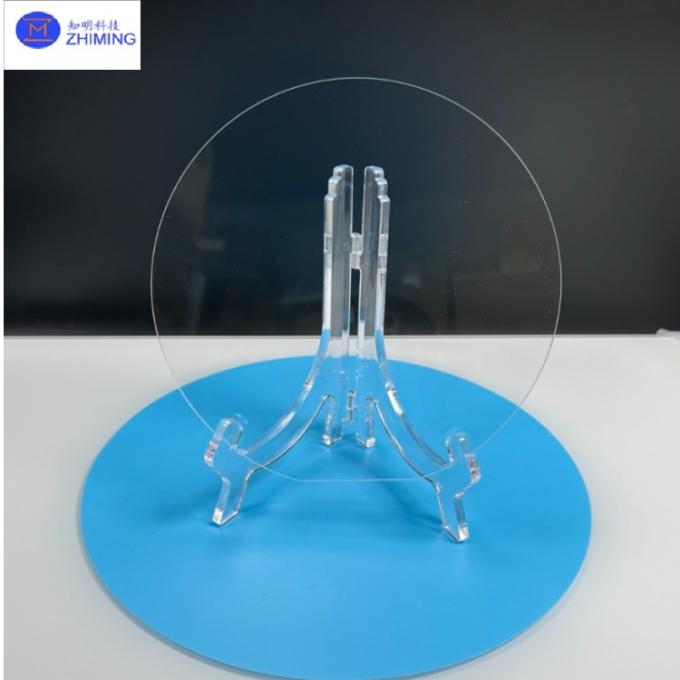
1. Enhanced Optical Performance
Optical waveguides are responsible for guiding and shaping light, ensuring that virtual images are accurately projected into the user’s line of sight. Conventional glass substrates have a relatively low refractive index (around 1.5–1.6) and moderate transparency, which can result in significant light scattering, absorption, and chromatic aberration, limiting display brightness and color fidelity.
Silicon carbide offers several advantages for AR optical waveguides:
- High refractive index: SiC exhibits a refractive index typically between 2.6 and 2.7, significantly higher than standard glass. This enables compact waveguide geometries, higher light-coupling efficiency, and reduced internal reflection losses.
- Low optical absorption: SiC demonstrates minimal absorption across the visible and near-infrared spectrum, allowing brighter and more vibrant virtual images.
- Broad spectral transparency: SiC remains transparent from ultraviolet to near-infrared, enabling the integration of multiple light sources, including micro-LEDs and laser projectors, which are increasingly used in high-end AR systems.
- Reduced chromatic dispersion: The uniform optical properties of SiC minimize color fringing and image distortion, critical for applications requiring high visual fidelity.
2. Superior Thermal Stability
AR glasses often generate heat from high-brightness light sources, compact electronics, and prolonged usage. Glass substrates are sensitive to temperature fluctuations, which can lead to thermal expansion, microcracks, and gradual degradation of optical performance.
SiC waveguides, by contrast, offer:
- High thermal conductivity (~370 W/m·K), which efficiently dissipates heat and prevents local hotspots that could impair optical clarity.
- Low thermal expansion coefficient, maintaining dimensional stability under temperature variations, ensuring consistent image alignment and focus.
- Resistance to thermal shock, allowing devices to withstand rapid temperature changes during operation without fracture.
3. Mechanical Strength and Durability
Wearable devices like AR glasses must endure mechanical stress, accidental drops, and daily handling. Traditional glass is brittle and prone to scratches and fractures. SiC’s inherent material properties provide:
- High hardness, making waveguides resistant to surface scratches and mechanical wear.
- Excellent fracture toughness, reducing the risk of catastrophic failure during impacts.
- Chemical inertness, ensuring long-term resistance to moisture, sweat, and environmental contaminants, which preserves optical clarity over years of use.
4. Implications for AR Device Design
The adoption of SiC as a waveguide substrate enables AR designers to:
- Build thinner and lighter optical modules without compromising image quality.
- Achieve higher brightness and optical efficiency for more immersive experiences.
- Extend device longevity and reduce maintenance needs, which is critical for consumer adoption.
- Support advanced optical features such as multi-wavelength projection, holographic imaging, and augmented overlays with minimal distortion.
5. Future Prospects
Silicon carbide is not only promising for AR glasses but also for other optical devices requiring high precision and reliability. Its combination of optical transparency, thermal stability, and mechanical robustness makes it a material of choice for next-generation wearable displays. As fabrication techniques for SiC mature and costs decrease, its integration into mainstream AR glasses is expected to grow, ultimately redefining user experiences in augmented reality.
In conclusion, SiC optical waveguides represent a foundational innovation in AR technology. By overcoming the limitations of traditional glass substrates, SiC enables brighter, sharper, and more reliable AR displays, paving the way for the next era of immersive wearable computing.